
Quietum Lab | Zero-Fatigue Audio for Sensory Overload, Sleep & Neural Detox
Quietum Lab builds zero-fatigue neuro-acoustic soundscapes for modern nervous systems. Not vibes. Not magic. Engineering.
We design audio as a tool to support:
- Down-regulation during sensory overload
- Sleep onset without irritation or loop detection
- Focus through masking control and signal-to-noise discipline
- Somatic release via controlled vibroacoustics
- Nervous system stabilization via bio-rhythmic co-regulation anchors
If it cannot be measured, shaped, and repeated with intent, we do not ship it.
The enemy: Audio Fatigue
Most “relaxing audio” on YouTube is built from short loops and bright, untreated samples. The brain notices. The nervous system reacts.
Audio Fatigue is the irritability that arrives when your auditory system detects:
- Hidden loops: repeating patterns your brain predicts, then rejects
- Digital glare: harsh presence energy that lives in the 2 to 4kHz zone
- Transient spikes: sudden edges that trigger micro-alerting responses
- Over-bright textures: high-frequency density that feels like strain, not calm
The result is familiar: you press play to relax, then you feel subtly annoyed, restless, or wired. That is not your fault. It is the signal.
Quietum Lab exists to remove that failure mode.
The engineering core
We treat the soundscape as a system:
- Masking as architecture, not noise
- Entrainment cues as subtle regulators, not gimmicks
- Stochastic math to prevent repetition
- Psychoacoustics to reduce perceived sharpness and alerting energy
- Vibroacoustics to involve the body, not only the ears
Below are the five proprietary pillars that power every protocol.
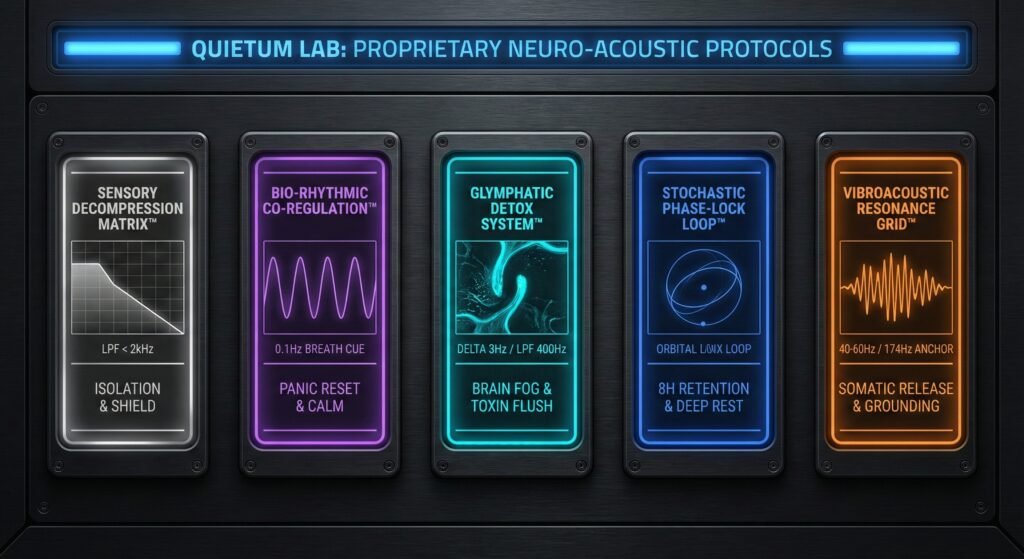
Our Technology
SENSORY (White/Silver)
Protocol Name: The Sensory Decompression Matrix™
Definition: Utilizes aggressive high-frequency roll-off (<2kHz) and static layering to simulate a submerged environment, creating a ‘cognitive shield’ against sensory overload.
Designed for the moment your environment becomes too loud, too bright, too fast. It creates a controlled “submerged” perceptual field where the brain receives fewer sharp edges to track.
REGULATION (Blue)
Protocol Name: Bio-Rhythmic Co-Regulation™
Definition: Uses close-mic psychoacoustics and a subtle 0.1Hz breath modulation cue to mimic a biological anchor, encouraging the listener’s heart rate to sync with a slow, safe rhythm.
Designed for nervous system stabilization. The goal is not sedation. The goal is safe rhythm.
SLEEP (Black)
Protocol Name: Stochastic Phase-Lock Loop™
Definition: Uses layers with coprime lengths (11, 13, 15 min) to ensure the audio landscape evolves mathematically without repeating a specific pattern for over 35 hours (LCM ~35.8h).
Designed to bypass loop detection. Your brain can scan for patterns all night and never “solve” the soundscape.
DETOX (Turquoise / Cyan)
Protocol Name: Glymphatic Detox System™
Definition: Engineers a strict 3Hz Delta frequency embedded within a 400Hz Low-Pass Filtered fluid dynamic texture. This creates subaquatic acoustic pressure to support metabolic clearance and reduce neurological friction without introducing transient alerts.
Designed for: Sensory hangovers, brain fog, and cognitive fatigue. It creates a controlled “wash” state where the brain is cleared of residual stress rather than forced into active concentration.
BODY (Amber)
Protocol Name: Vibroacoustic Resonance Grid™
Definition: Engineers low-end frequencies (40-60Hz) to create physical sympathetic resonance in the chest cavity, paired with a 174Hz grounding anchor for somatic tension release.
Designed for when the body is holding the stress. This is not just listening. This is felt sound.
Safety Standard
Zero-Fatigue Audio Engineering™
Protocol Name: Zero-Fatigue Audio Engineering™
Definition: We surgically remove digital harshness (2-4kHz glare) and sudden transients, ensuring our soundscapes are safe for neurodivergent sensitivities.
This is our baseline. Every release is built to be repeatable, stable, and non-irritating at sane listening levels.
The guarantee: no loop traps, no glare, no spikes
We do not promise miracles. We guarantee engineering principles.
What we guarantee:
- No short-loop architecture that the brain can predict in minutes
- No uncontrolled 2 to 4kHz glare that produces listening strain
- No transient ambush that can trigger micro-alert states
- Evolving soundscapes shaped by stochastic structure, not copy-paste repetition
Why the 35.8h claim matters
Loop fatigue happens when a system repeats quickly enough for the brain to map it.
Our Stochastic Phase-Lock Loop™ uses coprime layer lengths so the combined environment takes approximately 35.8 hours to align back into a fully repeated composite state.
That is the point: your brain cannot lock onto a repeating signature during real-world use.
Usage Guide
Which protocol do I need?
Use this as a practical selector. If you are unsure, start with REGULATION.
If you feel sensory overload (crowded spaces, noise sensitivity, screen fatigue, irritability):
- Choose SENSORY: The Sensory Decompression Matrix™
- Best use: short resets, commuting, open offices, overstimulating environments
If you feel wired or physiologically “stuck” (restless chest, shallow breathing, constant scanning):
- Choose REGULATION: Bio-Rhythmic Co-Regulation™
- Best use: evening wind-down, anxiety spikes, pre-sleep transition, after intense work
If your brain hunts patterns at night (can’t switch off, irritated by repetition, wake-ups):
- Choose SLEEP: Stochastic Phase-Lock Loop™
- Best use: sleep onset, background through the night, nap protocols
If your brain feels thick, fatigued, or you are experiencing a “sensory hangover” (brain fog, post-panic exhaustion):
- Choose DETOX: Glymphatic Detox System™
- Best use: Mid-day resets, restorative naps (90-minute ultradian cycles), post-stress decompression, and passive recovery.
If tension lives in the body (tight chest, jaw tension, somatic stress, need to “drop”):
- Choose BODY: Vibroacoustic Resonance Grid™
- Best use: low-volume speaker sessions, reclined listening, breathwork support
Simple SOPs
SENSORY SOP (10 to 25 minutes)
- Lower screen brightness and reduce additional stimuli.
- Set volume to low to moderate.
- Focus on the feeling of “distance” created by masking.
REGULATION SOP (15 to 45 minutes)
- Use headphones if available.
- Breathe naturally. Do not force pace.
- Let the 0.1Hz cue act as a background anchor.
SLEEP SOP (30 minutes to all night)
- Start at a low volume.
- Avoid “searching for the pattern.” It will not repeat in a meaningful way.
- If you wake up, do nothing. Let the soundscape remain stable.
DETOX SOP (90 to 180 minutes)
- Use headphones to ensure accurate 3Hz Delta binaural delivery.
- Set volume to moderate-low; the acoustic pressure should feel like physical weight, not loud noise.
- Allow the mind to drift. This protocol rewards passive surrender, not active attention.
BODY SOP (10 to 30 minutes)
- Prefer speakers that can reproduce low-end cleanly.
- Keep volume safe. The goal is resonance, not intensity.
- Place attention on chest and abdomen relaxation.
Stacking (advanced)
Some nervous systems respond best to sequencing:
- SENSORY → REGULATION for overload into calm
- REGULATION → SLEEP for shutdown into sleep onset
- BODY → REGULATION for somatic release into stable down-regulation
- SENSORY → DETOX for aggressive sensory overload followed by cognitive clearing.
Keep stacks simple. Consistency beats complexity.
Design principles behind every session
1) Masking with intent
Masking is not “more noise.” It is structured coverage that reduces salience of intrusive stimuli.
2) Entrainment cues, not coercion
We use subtle rhythmic and textural cues that encourage down-regulation. The listener remains in control.
3) Psychoacoustic comfort
We shape timbre to reduce perceived sharpness, especially in fatigue-sensitive regions.
4) System stability
No abrupt jumps, no surprise layers, no sudden brightness. The soundscape must feel safe.
5) Repeatability
A protocol is only real if it performs the same way across sessions, devices, and environments.
Scientific Disclaimer
Quietum Lab content is science-informed and designed for general well-being support, focus support, relaxation support, and sleep support.
- Not medical advice.
- Not a diagnosis.
- Not a treatment plan.
If you have a medical condition, use a medical device, experience seizures, have a history of epilepsy, or have any concern about sound sensitivity, consult a qualified clinician before use.
Always listen at safe volumes. Stop use if you experience discomfort, dizziness, headaches, or agitation. Use extra caution with headphones and extended sessions.
Quietum Lab sells tools: engineered sound environments. Outcomes vary by person, context, and baseline state.
Scientific References
- Hornsby BWY, Naylor G, Bess FH. A Taxonomy of Fatigue Concepts and Their Relation to Hearing Loss.Ear Hear. PubMed | PMC
- Ingendoh RM, Posny ES, Heine A. Binaural beats to entrain the brain? A systematic review of the effects of binaural beat stimulation on brain oscillatory activity, and the implications for psychological research and intervention.PLoS One. PubMed | PMC | DOI
- Söderlund G, Sikström S, Smart A. Listen to the noise: noise is beneficial for cognitive performance in ADHD.J Child Psychol Psychiatry. PubMed | DOI
- Alvarsson JJ, Wiens S, Nilsson ME. Stress recovery during exposure to nature sound and environmental noise.Int J Environ Res Public Health. PubMed | PMC | DOI
- Klimesch W. Alpha-band oscillations, attention, and controlled access to stored information.Trends Cogn Sci. PubMed | PMC | DOI